
Contract Review Checklist: Terms to Find First
A checklist of the terms to find first in a supplier contract: parties and dates, payment, renewal and termination, liability and confidentiality, governing law, and when to get advice.
Before you sign a supplier contract, you do not have to understand every clause, but you should know where a few terms are and what they say. This checklist lists the terms to find first: parties and dates, payment, renewal and termination, liability and confidentiality, and governing law. The Contract Key Terms Extractor finds these in pasted text and shows the clause for each.
Before you paste a contract, remove the names and amounts that you do not want to send. The text is analysed by an AI service, and the terms do not depend on personal or confidential details. Then press Extract key terms.
Parties and dates
Start with the basics. Check that you know who is bound and from when.
- Are the names of the parties correct, with the legal name and not a brand name?
- What is the start date, and is it a calendar date or "the date of the last signature"?
- How long does the first term last?
- Is there anything that has to be done before the contract starts?
Wrong party names are a common error, and a contract with the wrong legal entity may not bind the one you meant. Dates matter because every other period, such as notice and renewal, is counted from them.
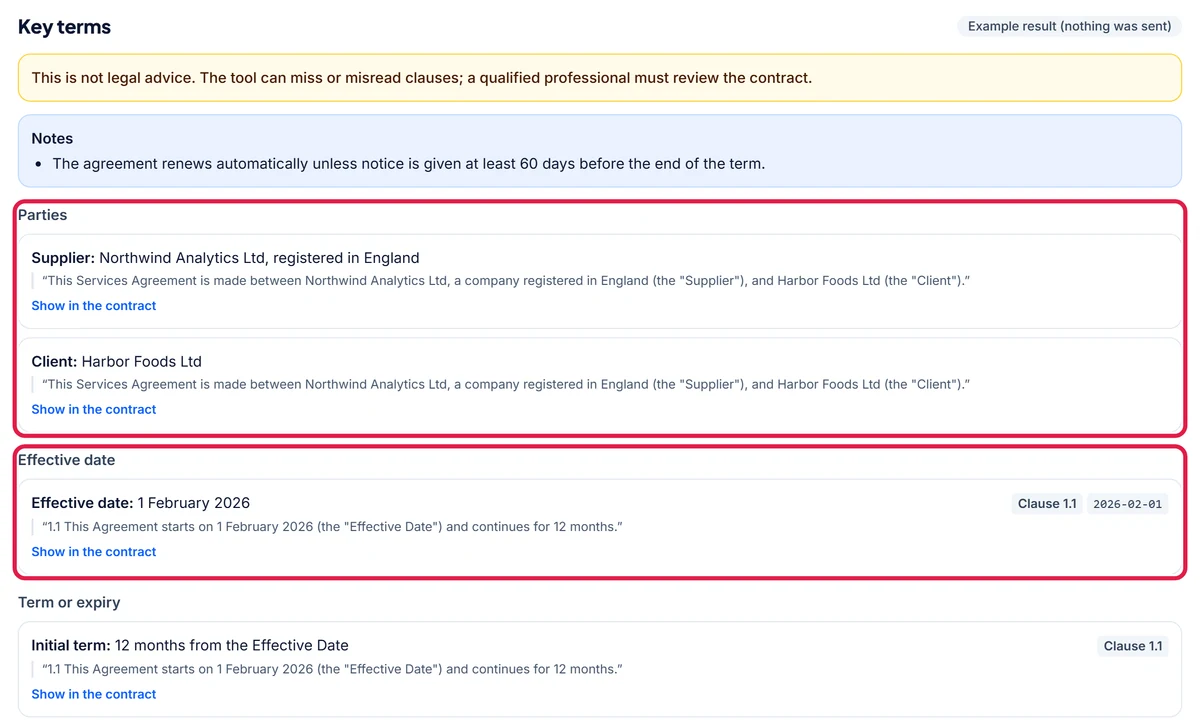
The result of the extractor is grouped by category: Parties, Effective date, Term or expiry, Payment, Renewal, Termination, Obligations, Governing law, Confidentiality and Liability. Use the list of groups as your map of the contract. Dates in the result are written as YYYY-MM-DD, which removes the doubt between day and month.
Payment
Find out what you pay, when and under what conditions.
- What is the amount, and for what period: per month, per year, per project?
- Are taxes such as VAT included or added?
- When is the invoice due, and what happens if payment is late?
- Can the price change during the term, and how?
The extractor tags amounts in a normal form, such as 4,500 GBP, and shows the clause with a quotation. Read the clause for conditions that the summary does not show, such as an annual price increase.
Renewal and termination
This is where contracts surprise people. Find the answers to these questions:
- Does the contract renew by itself?
- For how long does it renew?
- How much notice is needed to stop it, and how must the notice be given?
- Can you end it early, and at what cost?
Work out the last day for notice and put it in your calendar. The method is in Find Renewal and Notice Dates in a Contract.
Liability and confidentiality
Liability clauses decide how much one side can claim from the other if something goes wrong. Look for a cap and for exclusions.
In an example, liability is capped at the fees paid in the 12 months before the claim. For a supplier, that is a normal kind of limit, but it also limits what you can recover. Compare the cap with the harm that a failure could cause to your business.

Confidentiality clauses say what information each side must keep secret and for how long. Check that the clause works both ways if you also share sensitive information, and note how long it lasts after the contract ends.
When the text has no such clause, the extractor does not fill the category. It lists it under "Not found in this text" with the line "Nothing is filled in for these: check the full contract and its annexes." That is useful: a missing liability or confidentiality clause is a point to raise. It may also mean that the clause is in a document that you did not paste, such as terms attached to the contract, so check for that.
Governing law
Find which law applies and where disputes are settled. A contract under the law of England and Wales, for example, is read under that law, and the courts or the arbitration named in the contract decide disputes.
Check that the law is one that you can work with. A supplier from another country can choose its own law and courts, and a dispute is then far from you and costly. This is a point to negotiate when the value of the contract is high.
When to get legal advice
The tool shows a disclaimer, and it applies in full. It finds and organises what the text says. It does not tell you whether a clause is enforceable, fair or valid, and it does not answer legal questions.

Get advice from a solicitor or another qualified adviser when the contract is of high value or long, when a clause limits your liability in a way that surprises you, when you do not understand a clause that matters, or when the other side refuses to change terms that put you at a clear disadvantage. A review by a professional costs less than a dispute.
For a longer description of what the extractor returns, see Extract Key Terms From a Contract: Dates, Fees, Renewal. For a short summary of the whole text, the AI Document Summarizer is available.
Try it
Open the Contract Key Terms Extractor, remove names and amounts that you do not want to send, paste the contract and press Extract key terms. Go through this list category by category, read the clause behind each term, and note the categories that are Not found in this text.