How to Stop Impulse Buying Online With a 48-Hour Rule
Learn how to stop impulse buying online with a 48-hour wait, a wishlist and a price alert, plus a one-week experiment you can run yourself today.

Think of the thing sitting in your cart right now. In a month, you probably won't remember buying it, but you'll remember the bill.
Here's how to stop impulse buying online with one rule: wait 48 hours. Below are the six steps, why waiting works, and a one-week experiment you can run yourself. I haven't run the experiment, so the results will be yours. The research comes from a University of Michigan dissertation, the FTC, Amazon and Google, which I read on 14 October 2026.
Quick answer: To stop impulse buying online, move the item from your cart to a wishlist, set a price alert, write one line on why you want it, then wait 48 hours before deciding. A University of Michigan experiment found a 25-hour delay lowered the urge to buy.

What do you need, and how long does it take?
Setup takes about 5 minutes. Each item then waits 48 hours. Have these ready:
- A wishlist, either in the store's app or in a notes app.
- A way to get price alerts, such as the store's app or a browser tool.
- A notes app for one-line reasons.
- Your phone, for a reminder two days out.
The catch: the rule only works on what you buy for fun or on a whim. Groceries, bills and a broken fridge shouldn't wait 48 hours. You decide what counts as essential, and you decide before you shop.
How to stop impulse buying online: 6 steps
Step 1: Write the rule in one sentence
Something like: "Nothing non-essential gets bought for 48 hours." Put it in your notes app where you'll see it. A rule you have to remember isn't a rule.
Step 2: Park the item on a wishlist
Take it out of the cart and put it on a list. In Amazon's case, you use the Add to List drop-down on a product page, and the app can send a push alert when the price drops. Lists stay private until you share them.
Other shops have similar features. If yours doesn't, bookmark the page or paste the link into your notes.
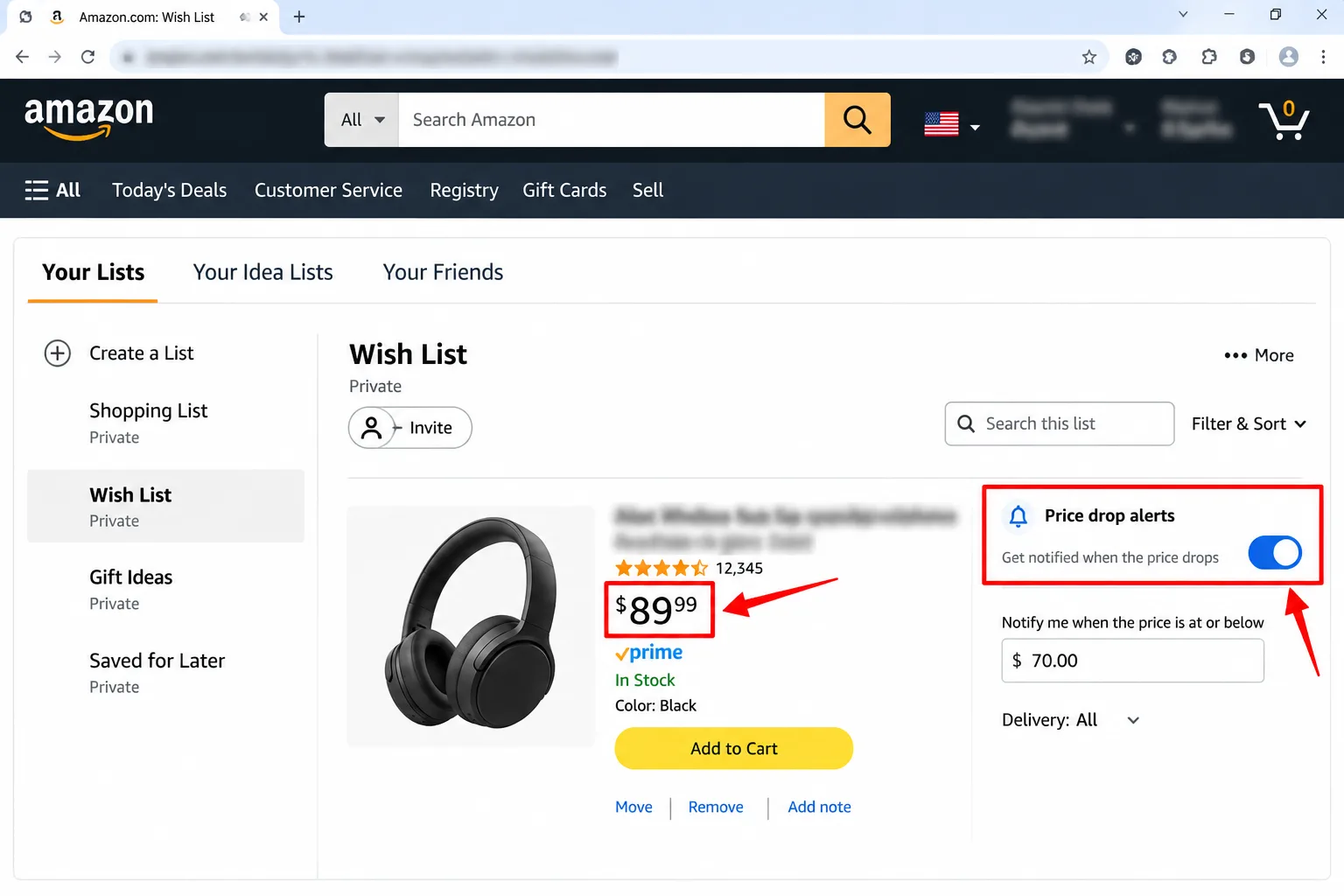
Step 3: Set an alert and write one line
Switch on a price alert for the item. That removes the fear of missing out, because the store, or a tool, will tell you if the price drops. For a way to check whether a "sale" is real, see our price history checker guide.
Then write one line: the item, the price, today's date, and why you want it. This takes a minute. In the Michigan work, asking people to list reasons for and against a purchase for about three and a half minutes also lowered the urge to buy.
Step 4: Add friction at checkout
Make buying slightly harder. Chrome users can turn off Save and fill for payment info under Passwords and autofill, then Payments, or delete a saved card. Sign out of the shop too.
Unsubscribe from the promo emails that trigger you. In the US, the FTC says senders must honour an opt-out within 10 business days, so it can take a little while to bite.
Step 5: Wait 48 hours, and don't browse
Set a phone reminder for two days out. Then do something that isn't shopping. The Michigan study found that a 10-minute delay didn't significantly reduce impulse purchases. Every participant kept shopping during it.
Step 6: Decide with three questions
- Do I still want it?
- Did I have a use for it before I saw it?
- Is today's price fair?
If it's still a yes, buy it properly. Look for a code with our guide to how to find hidden discounts online, then follow the order in how to stack coupons and cashback. If it's a no, delete it and enjoy the small win.
Why does waiting work?
The best evidence I found is a University of Michigan dissertation. In an online experiment, a 25-hour delay lowered the felt urge to buy impulsively and reduced purchase intent. A 10-minute delay in a lab setting did not produce a significant drop.
My reading: the urge fades once ordinary life gets in the way, so the delay has to be long enough for that. I chose 48 hours because it covers two nights and is easy to remember. That's my rule of thumb, not a tested threshold.
There's also the store's side. The FTC has warned about countdown timers designed to make shoppers believe they have limited time, even when the offer isn't time-limited. A timer on the page isn't your deadline.
The catch: one study isn't a guarantee. People differ, and an experiment about the urge to buy is not proof you'll spend less.

What is the one-week experiment?
Run it for seven days. It takes a few minutes a day.
- Day 1: write the rule and make a list in your notes with four columns: item, price, date parked and verdict.
- Days 1 to 7: every time you want something non-essential, park it on the list instead of buying. Set the 48-hour reminder.
- After 48 hours: decide with the three questions in Step 6 and fill in the verdict.
- Day 7: count the items, the ones you bought and the ones you deleted. Add up the prices of the deleted ones.
The catch: that total is what you didn't spend, not necessarily what you saved. If you'd never have bought a thing, it doesn't count. Be honest, and the number will still be a useful one.
What mistakes break the rule?
- Shopping while you wait. The Michigan delay failed when people kept browsing.
- Stretching "essential". If most things qualify, the rule does nothing.
- Believing the timer. A countdown clock may not be a real deadline.
- Skipping the one line. Without a reason on paper, you'll decide on mood.
- Letting the list grow forever. Clear it once a week, or it becomes another cart.
What if it fails?
- You bought anyway: check the store's return window, and whether it has a price adjustment policy if the price drops after you've paid.
- You keep caving: apply the rule only to purchases above a set amount at first, then lower it.
- The deal ends before 48 hours: check the price history. If it's an ordinary price with a "sale" label, let it go.
- The item sells out while you wait: accept that this will sometimes happen. It's the price of the rule, and you'll usually find a similar item.
My take and next step
Knowing how to stop impulse buying online comes down to taking the clock back from the store. My pick: 48 hours for anything non-essential, plus the one line on why. Skip this if: it's a true need, such as a broken appliance, or a deal you've already checked is unusual.
Next step: run the one-week experiment starting today, and park your first item before you close this page. More ways to pay less are in the Money-Saving Guides hub.
Last checked: 14 October 2026, against the University of Michigan, FTC, Amazon and Google pages named above. App features and policies change, so confirm them in the app you use.
Frequently asked questions
What counts as an impulse buy?
Anything you didn't plan before you started shopping. A useful test: could you have named it, and the reason for it, the day before? If not, it goes on the wishlist for 48 hours. Planned replacements and essentials are exempt.
Can price alerts make me spend more?
They can, if every ping sends you shopping. Limit alerts to wishlist items that already passed the wait, and set a target price. Amazon's guide says push alerts for price drops are optional in its app, so you can switch them off.
Are wishlists private?
On Amazon, lists are private until you share them with the Invite button. Other stores differ, so check the privacy setting before you add anything embarrassing, or keep the list in your own notes app instead.
Quiz
Stop Impulse Buying: Shop Smarter, Save More
10 quick questions — think you know this one?
Test Your Knowledge →Comments (7)
- R
Riley
4 days ago
I’ll definitely be checking out more articles on Perktonic.
- D
Drew
5 days ago
I found this post useful and informative.
- P
Pat
Oct 10, 2026
I’ll be sharing this article with a few friends.
- C
Chris T.
Oct 3, 2026
I enjoyed the article and found it easy to follow.
- J
Jordan
Sep 29, 2026
Keep up the excellent work!
- C
Casey
Sep 20, 2026
A simple, clear, and informative article. Great job!
- R
Robin
Sep 19, 2026
Very helpful and easy to follow.